

COM.Geo
2012 was a huge success on July 1-3! All of our organizers
and attendees overcome various kinds of the difficulties
caused by the broadest power outage in history of DC area
due to unexpected natural disasters. Thanks all of you who
helped make this conference such a huge success under such circumstances.

COM.Geo 2013
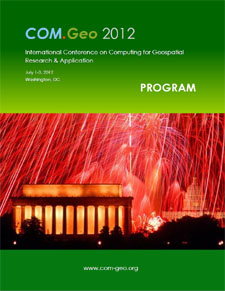
COM.Geo 2012
A Huge Success
A Huge Success
Full Conference Program
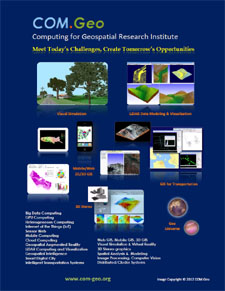
Microsoft Workshop: Getting Started with Creating Windows 8 Apps Using Geospatial Data

Highlights
Let's reveal these at COM.Geo 2012 through our leading industrial,
governmental, and academic experts' insightful thoughts and
inspiring discussions in their keynote speeches, panel discussions,
paper presentations, technical talks, workshops, courses,
posters, etc. >>
US President Barack Obama’s administration announced a ‘Big
Data’ research and development initiative in response to processing
the large amount of data collected by geospatial and other systems.
Under this initiative, several federal government agencies,
NSF, USGS, DARPA, DOD, NIH, and DOE, commitment for the programs
total $200 million. >>
Today's GPUs are powerful for general purpose computing -- General
Purpose Computing on the Graphics Processing Unit (GPGPU). GPGPU
leverages the microprocessors that power many modern graphics
cards. GPGPU has great promise for bringing the distributing
processes to the geospatial research and application.
>>
What will be a world characterized by sensors everywhere? How
to handle sensor data explosion in such a world? COM.Geo 2012
will further bring more new thoughts to explore sensor computing
for geospatial research and application.
>>
Latest Updates
May 25, 2012
Aug. 2, 2011
COM.Geo 2011 proceedings have been published by
ACM, and available now at ACM
Digital Library for world distribution.
Keynote/Featured Note Speakers
|
COM.Geo
|
USGS
|
GWU/COM.Geo
|
OGC
|
|

Dr. Lindi Liao
President & Chief Scientist
COM.Geo Conference General Chair |
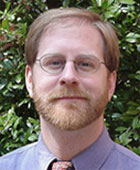
Dr. David Applegate
Associate Director, Natural Hazards, USGS; Chair for
NSTC's Subcommittee for the White House Office
|
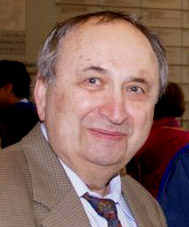
Dr. Simon Berkovich
Professor of Engineering & Applied Science, George
Washington University, Senior
COM.Geo Advisor
|
||
|
Keynote Video Slides:
A Promising Future of Computing for Geospatial Technologies
|
Keynote Video Slides:
On Clusterization in "Big Data" Streams
|
|||
|
Oracle
|
Nokia
|
ICF International
|
U.S. DOT
|
|
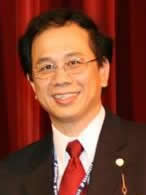
Dr. Phil Yen
Principal Bridge Engineer & Program Manager, U.S.DOT-FHWA,
COM.Geo 2012 Keynote Chair
|
||||
|
Keynote Video:
Big Data and Advanced Spatial Analytics
|
Keynote Video:
Big Data Computing for Traffic Information by GPS Sensing
|
Emerging Tech Panels+
What happens when you have connected sensors in everyone's pockets, homes, vehicles, workspaces, street corners, shopping areas, and more? With the convergence of Mobile Computing, the Internet of Things (IoT), and the ability to gather and analyze this Big Data, the availability of massive amounts of information will continue to be gathered and you can expect the unexpected to happen. Read More >>
Moderator: George Percivall,
Chief Architect & Executive Director - Interoperability Program,
OGC
Panelist:
Xavier Lopez, Director, Spatial and Semantic Technologies,
Oracle
Kipp Jones, Chief Architect, Skyhook Wireless
Paul Wilson, Market Segment Leader, GE Energy / MapFrame
Mobile Solutions
Joel Reyes, Senior Developer Evangelist for Mobile Computing,
Microsoft
Kevin Montgomery, CEO, Intelesense Technologies
The amount of data each organization deals with today has been rapidly growing. However, analyzing large datasets commonly referred to as “big data” has been a huge challenge due to lack of suitable tools and adequate computing resources. Why are organizations, both in public sector and private sector, so keen on unlocking business insights from all structured and unstructured data? What is the current state of big data solutions and service providers? How effective are some of the solutions that have been put into real world practices? What’s the current state of cloud computing technologies? What impacts have cloud computing technologies available in public clouds and private clouds had on the way organizations addressing big data challenges? How to secure big data in the clouds? What are the future roadmaps for cloud-based big data solutions, Read More >>
Moderator: Dr. Zhiming Xue,
Senior Architect Evangelist for Windows Azure cloud computing at
Microsoft
Panelists:
Dr. Simon Y. Berkovich, Professor, George Washington University,
Senior Advisor at COM.Geo
Dr. Larry Feldman, Lead Associate, Booz Allen Hamilton
Dr. Olli-Pekka Tossavainen, Researcher, Nokia
Dr. Shyam Parhi: Computer Scientist for Airport GIS, U.S.
DOT - FAA
Dr. Kevin Montgomery, CEO, Intelesense Technologies
The ever growing necessity for Big Data processing within the industry, government, and specially within defense applications causes the need and requirement for the fast development of new technologies. In addition, the protection of Big Data can be a serious problem because security is commonly an afterthought during technology development, and the exponentially increasing rate at which new data is generated presents many challenges. Read More >>
Moderator:
Dr. Robinson Pino, Senior Scientist, ICF International (ever
worked at DARPA & Air Force)
Panelists:
Dr. Douglas Kelly, Branch Chief, Army Research Laboratory, Network Security Branch
Dr. Arthur H. Edwards, Senior Research Physicist, Air Force Research Laboratory, Space Vehicles Directorate
Mr. Michael Shevenell, Project Manager, ICF International
Dr. Bryant Wysocki, Ret Maj USAF, Senior Electronics Engineer, Air Force Research Laboratory, Information Directorate
Dr. Larry Feldman, Lead Associate, Booz Allen Hamilton
(Defense Consulting Firm)
Dr. Alexander Davydov, Senior Scientist, COM.Geo (ever worked
for DOD)
Dr. Kevin Montgomery, CEO, Intelesense Technologies
(Defense Consulting Firm)
Moderator:
Dr. Phil W. Yen, Principal Bridge Engineer & Program Manager,
U.S. DOT - FHWA
Member of NSTC's Subcommittee on Disaster Reduction for the White House Office
Panelists:
Gregory I. Snyder, Manager, LIDAR Program Development, Land
Remote Sensing Program, USGS
Dr. Olli-Pekka Tossavainen, Researcher, Nokia
Dr. Peter C. Chang, Professor, University of Maryland
Sponsors
 |
 |
 |
| Platinum Sponsor | Bronze Sponsor | Supporting Sponsor |
 |
 |
|
| Publishing Sponsor | Publishing Sponsor |
Partners
 |
 |
 |
 |
 |
Media Sponsors
 |
 |
 |
| Premier Media Sponsor | ||
 |
||